
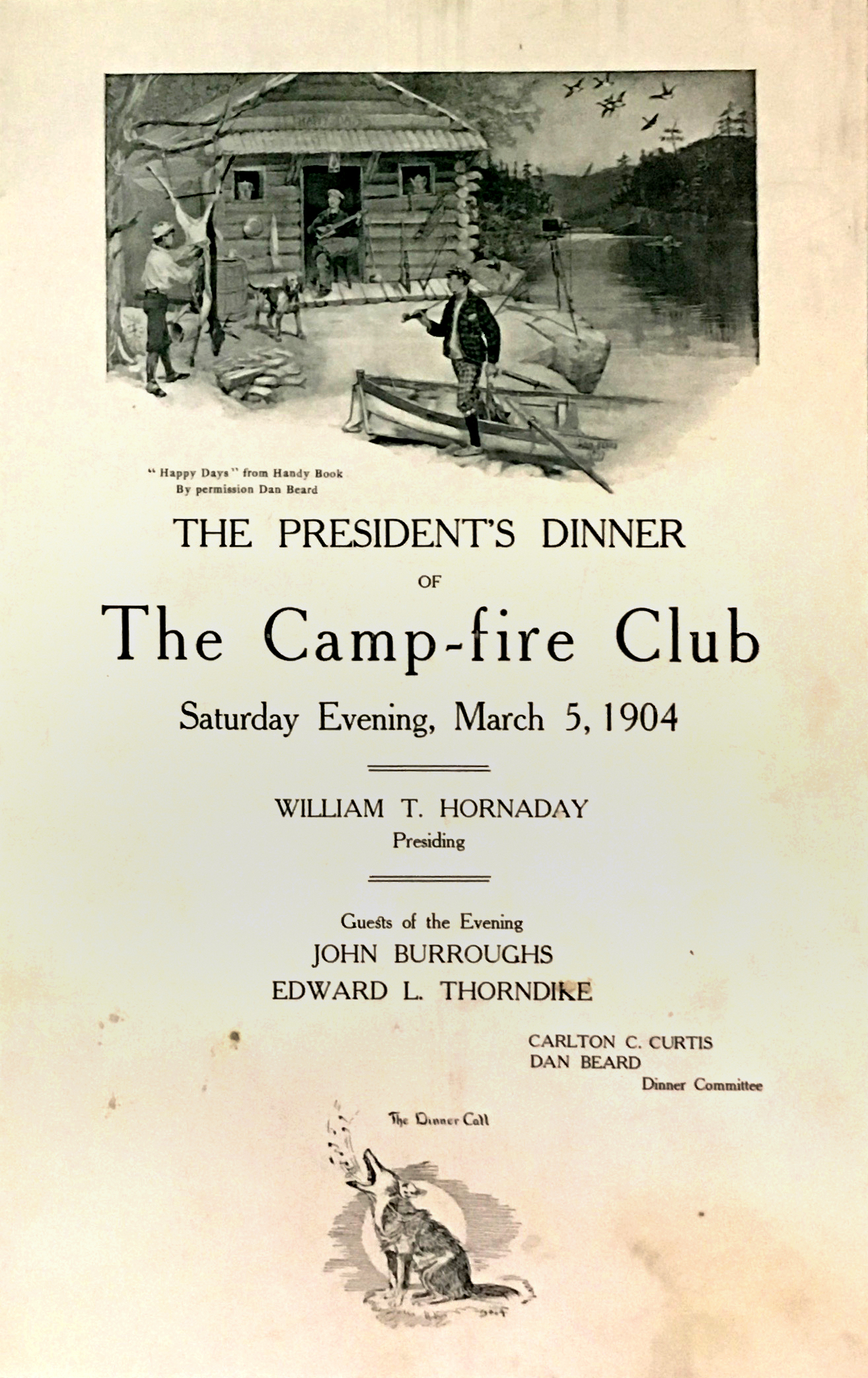
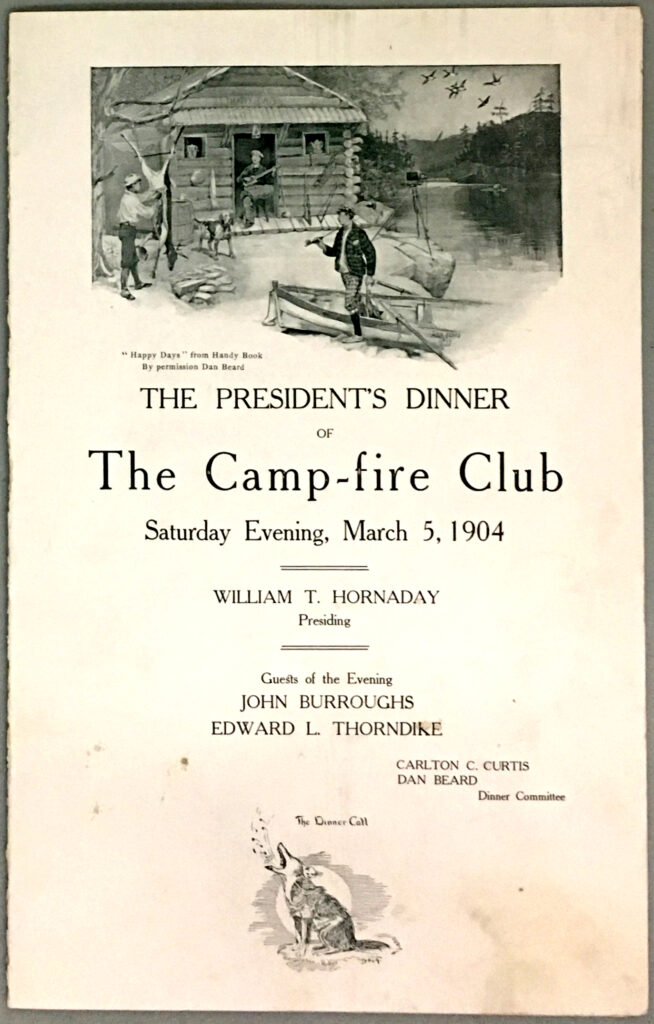
“[William T. Hornaday] found in his new habitat a goodly company of men who had distinguished themselves in the open with the rifle and the brush. Imbued with the get together, spirit, so strong among sportsmen the world over, and personally bearing a burden of many unswapped experiences in various parts of the great outdoors, it seemed to him but one thing was necessary, to bring together around the camp-fire the kindred spirits of Manhattan Borough and give each sportsman an opportunity to relieve himself of the burden of his various hunting stories and to compare notes with his fellows on game district, equipment and the many details so dear to anticipation.”F&S 605 1910
F&S 605 1910
Founded in 1887 by William T. Hornaday, the NYZS—, the Camp-Fire Club was committed to “the preservation of wildlife habitats, the primitive arts of the outdoors life, and the wise use of natural resources” (Quiet World, p. 96) and began with a limited membership of “the foremost sportsman, scientists and artists in the field of out-door life” (F&S 603 1910). The Club’s membership, first limited to fifty, was, to the chagrin of some early members (citation), eventually broadened to include less elite sportsmen (F&S 603 1910) with the only requirement for membership being, “proven manhood where the spirit of the camp fire reigns supreme” (F&S 604 1910).
Find a place for the white supremacy info.
Field and Stream awards article
Pull info from IMG_4223.pdf and IMG_4211.jpg
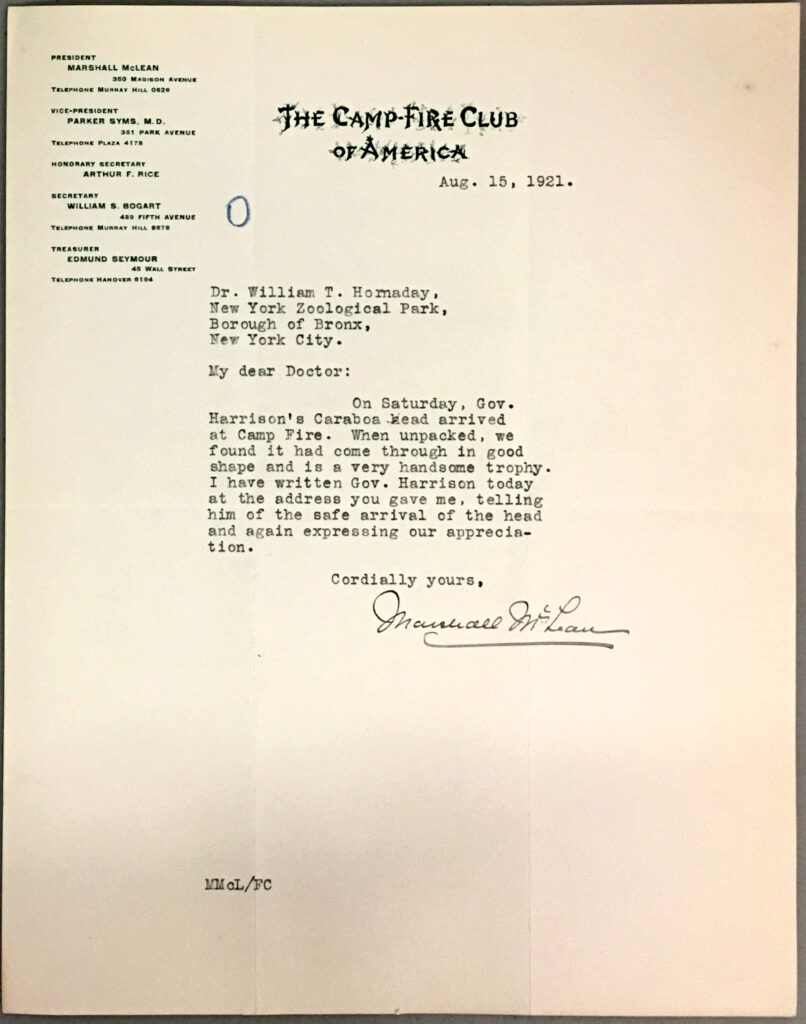
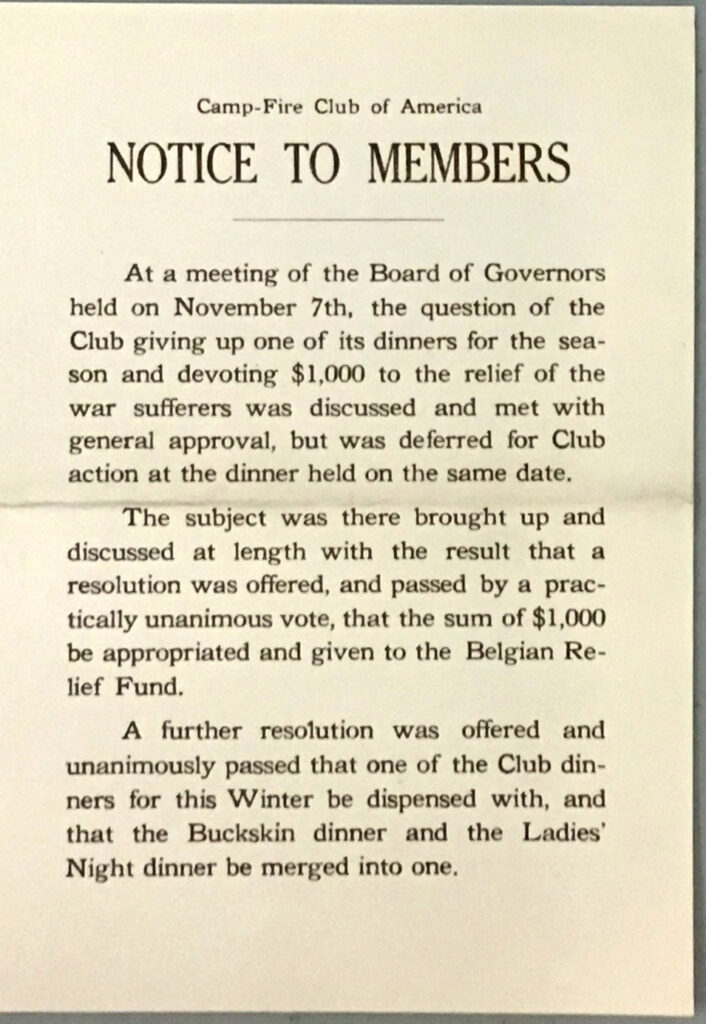
In part, Hornaday founded the Club in response to how disgruntled he had become with the Boon and Crocket Club, another outdoor club, and its emphasis on trophy hunting (Quiet World, p. 97). Initially more social in nature, the Club became increasingly focused on the preservation of forest and animal life, speaking before congressional committees about such concerns as the slaughter of fur seals, the need to protect wildlife in Mount McKinley National Park, and the use of automatic shotguns in hunting.
Campfire Club gatherings, be they outdoor excursions or lavish dinners (both of which they held regularly), were filled with storytelling or, what they called, “talking it over.” The “it” was their adventures and discoveries in the great outdoors: “The tales of adventure, both in the old days and in the new, the stories of discoveries by the scientists, the naturalist and the explorer all come to the members first-hand” (611). Value and importance of stories… The Club, which required confidentiality from its members… explicitly states in its constitution that stories told by members or guests are not to be shared or published and any form unless the storyteller gives permission. (CFC Constitution 16 IMG_4231)
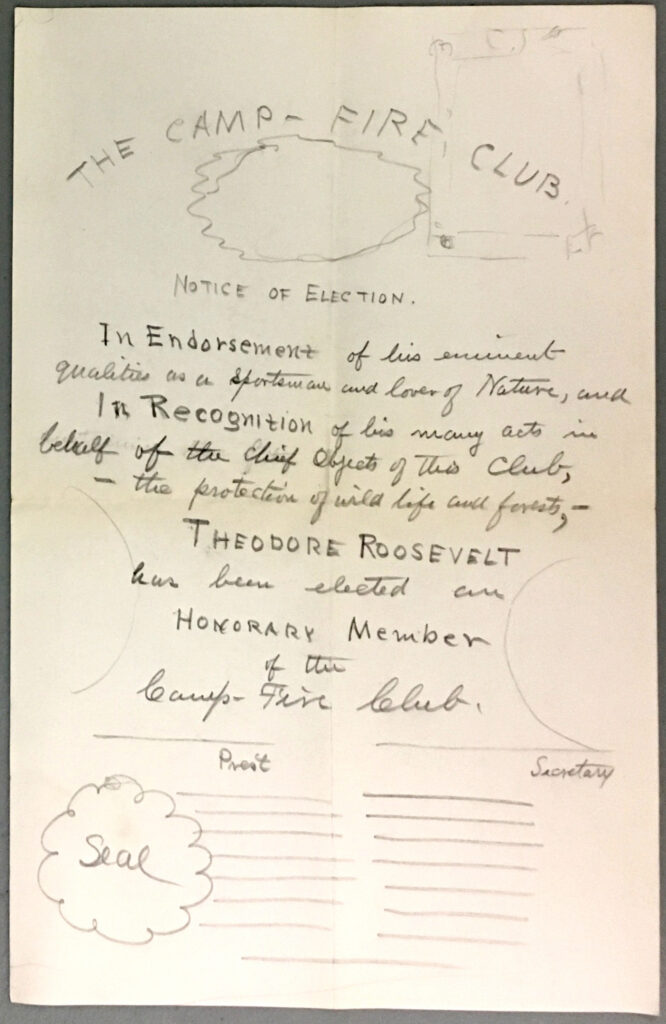
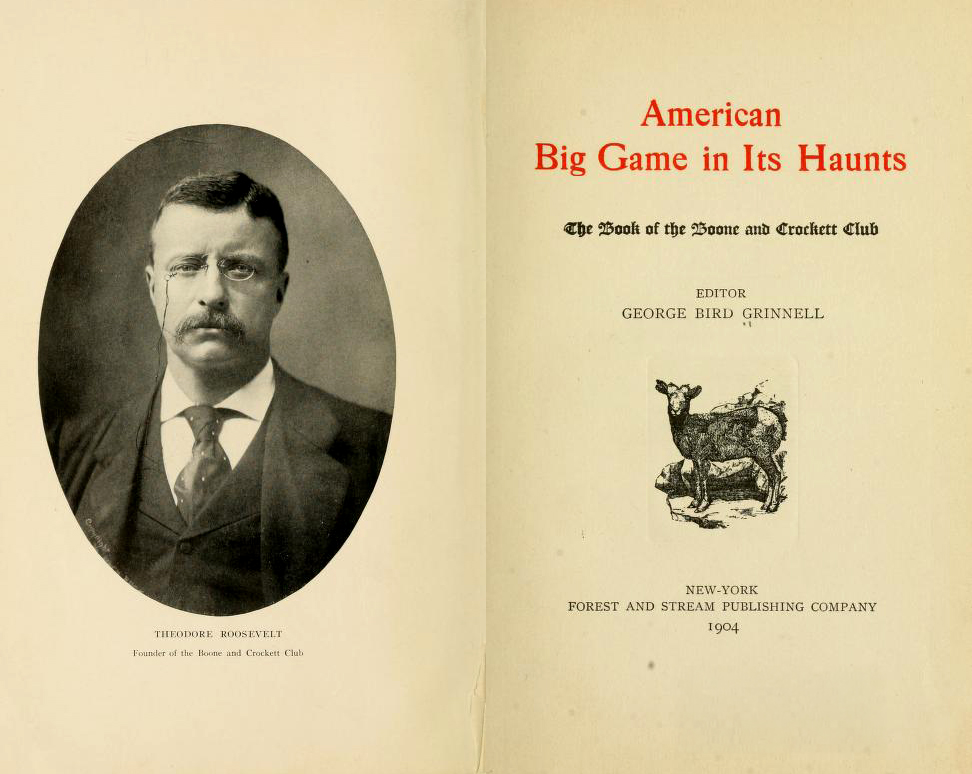
Theodore Roosevelt
“It was unanimously voted that Theodore Roosevelt, in endorsement of his eminent qualities as a sportsman and lover of nature, and also in recognition of his many acts in public and private life in sustain and enforcing the constitution of this club, namely, the Preservation of the Forests and the Protection of Wild Animals, Birds and Fish; and being credibly informed that he has camped in a howling wilderness, and killed big game, and thus fulfilled the requirements of membership in the club.”
A draft of a annoucement cfc_IMG_4244
Theodore Roosevelt, the nation’s foremost conservationist and would be president, was made the Club’s first honorary member in [data]. At a 1910 dinner, Roosevelt was awarded the CFC’s gold metal for eminent service (NYT)… Despite the venue’s extensive efforts to keep reporters away, the NYT… Held at the Waldorf Astoria, the roof on which it was held was decked out to look as much like a campground in the woods, tents and all (NYT).
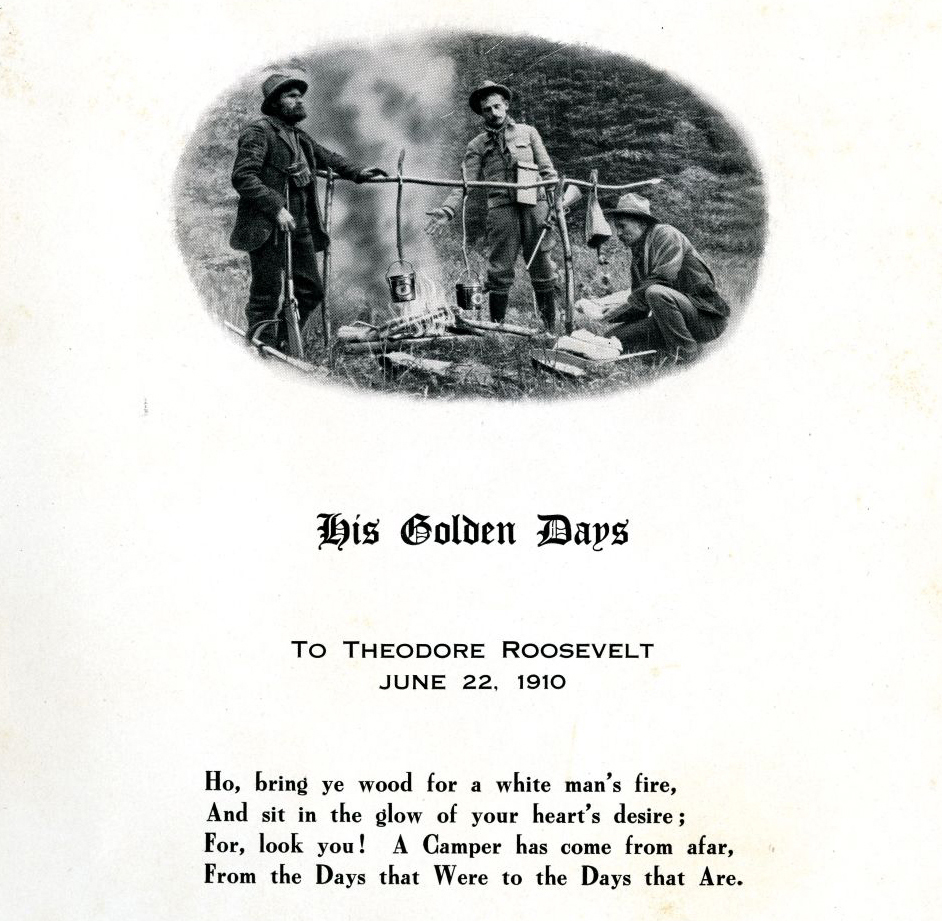
In the November 1910 Field and Stream article, “The Story of the Camp-Fire Club,” author Kenneth Fowler lays the foundation of the Club’s history and principles using the Aryan myth. He writes:
In the Fatherland of all Fatherlands, our earliest ancestors of the Aryan family rubbed together sticks from their beloved Himalayan forest, produced fire, and rejoiced in the glow of their hearthsides.–At the last outing of the CAMP-FIRE CLUB in the woods of “Wyndygoul,” Ernest Thompson Seton bore a slab of balsam with a drill of the same wood, brought forth a spark, then flame–the birch logs sputtered and flared and the camp-fire was a glowing reality, flooding the soul with throbbing vivid memories–primal impressions coming from the depths of time and the race, the wanderlust playing on the wild tense chords of uncharted ages.–The spirit of the Camp-Fire Club is the spirit of the camp-fire.
(601)
This myth, which is based on the false claim that there was an Aryan people from who Europeans descended, emerged in the 19th century and has since been used to justify and fuel the belief that white people are superior; that they created civilization and, thus, that they should determine all matters of society–who is in, who is out, who gets what, what is moral, what is legal, what is civil, and, so on. (Taking to its most extreme, it determines freedom and lives.) The power of this myth within the context of the Club is evident when Fowler makes his intent clear by stating, “It is possible to trace in the history of the white races an unbroken tie between man and nature” (614/615). In short, Fowler’s claim is that white men are the arbiters of nature.