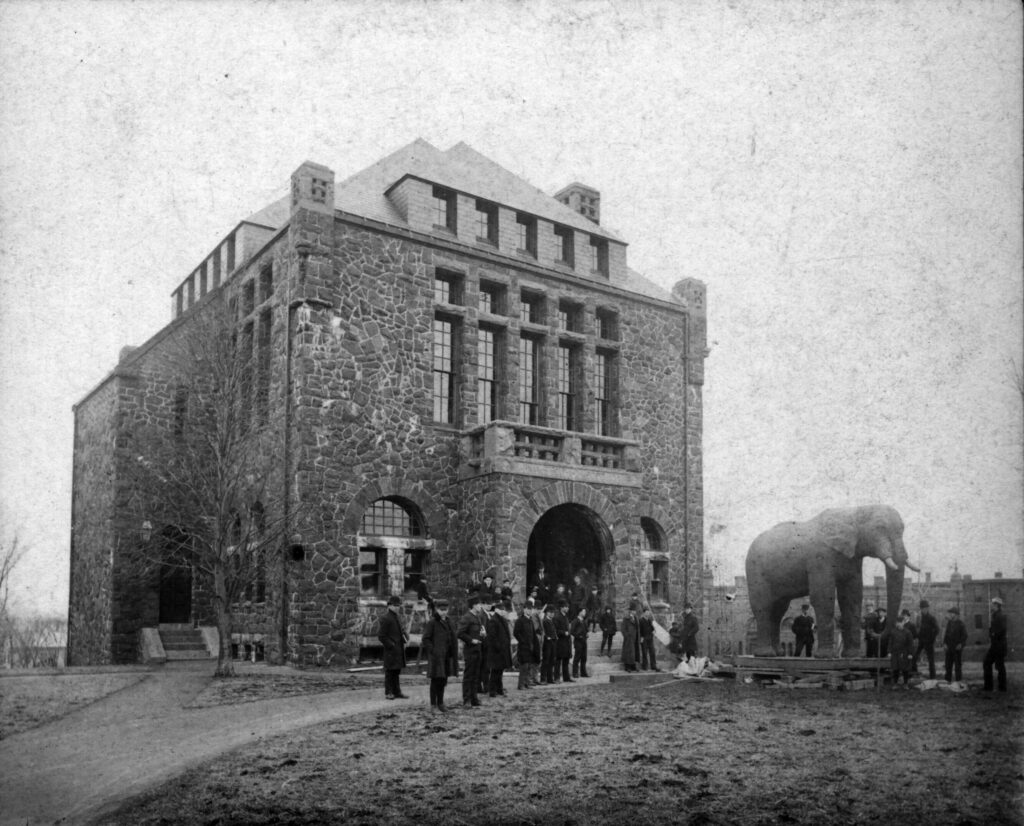
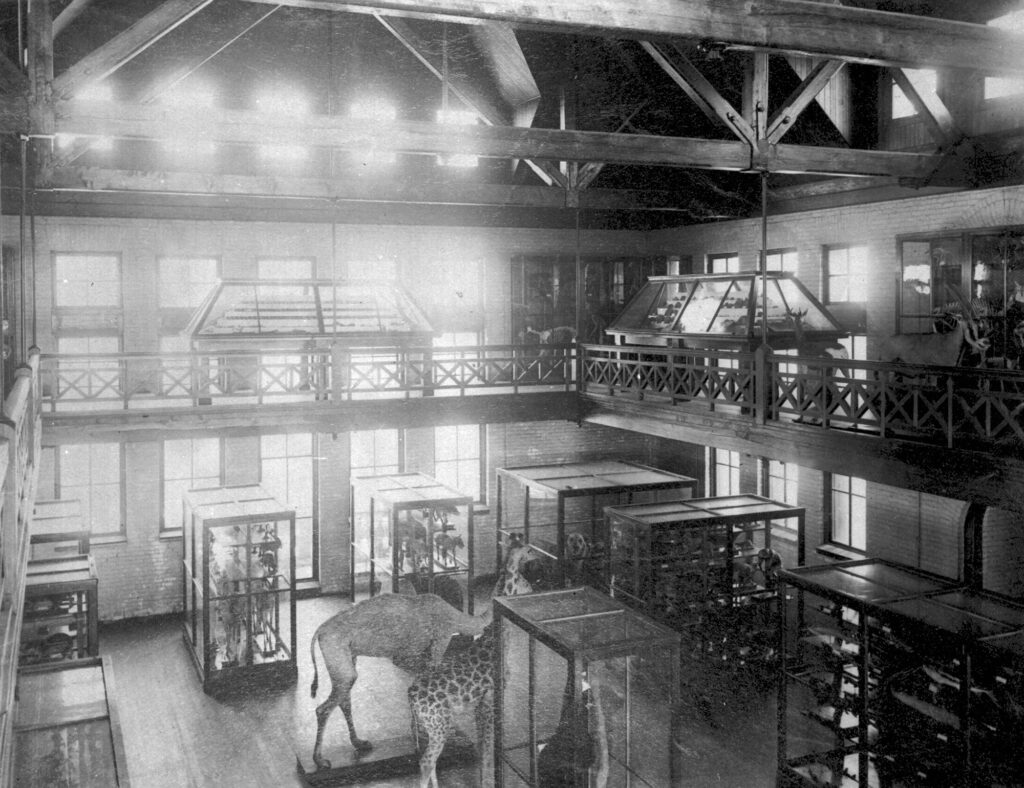
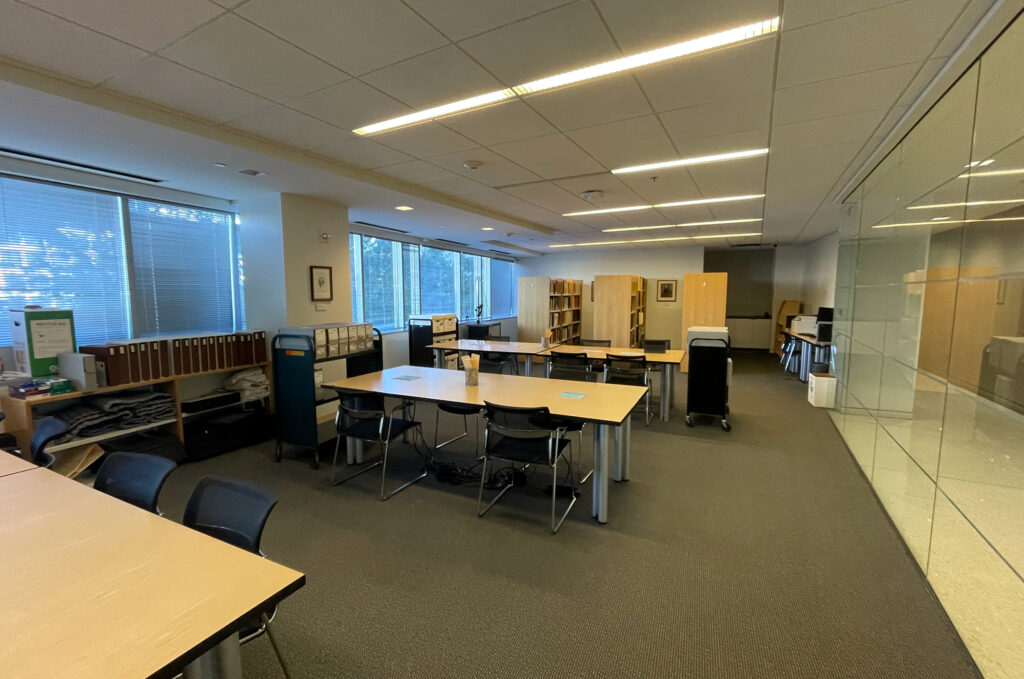
Founded in 1846, the Smithsonian Institution Archives collects, preserves, and provides access to a vast number of records and materials associated with the institution, its twenty-one museums, and the National Zoo (CITE).
Helped me understand how much it’s about the act of collecting…
Casting a wide net
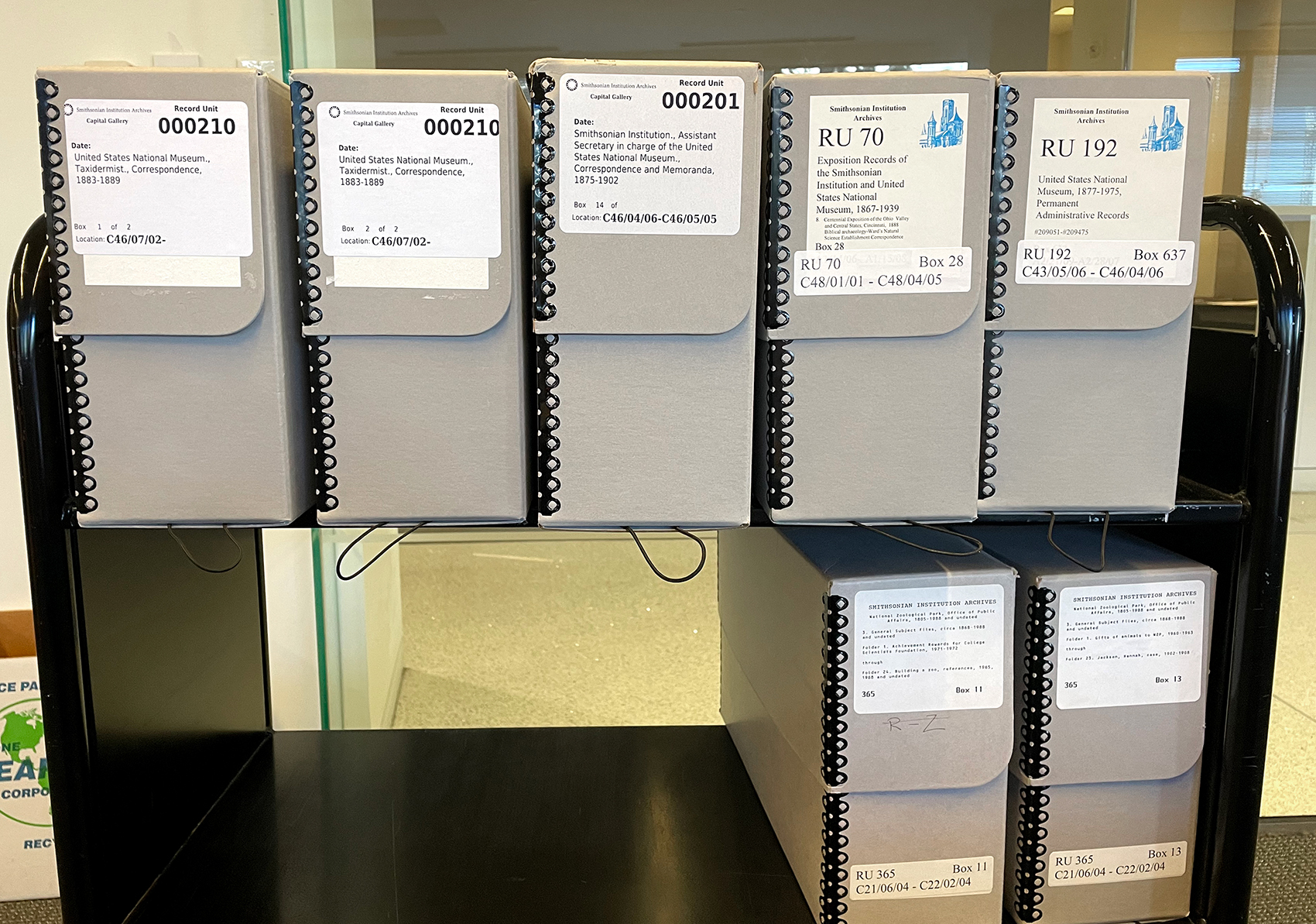
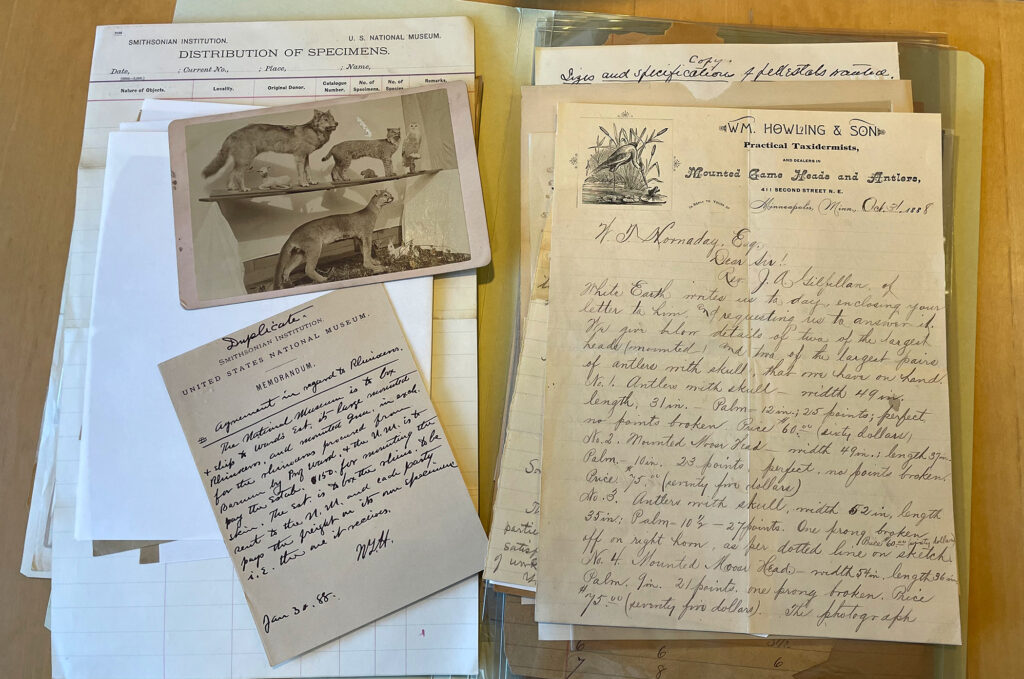
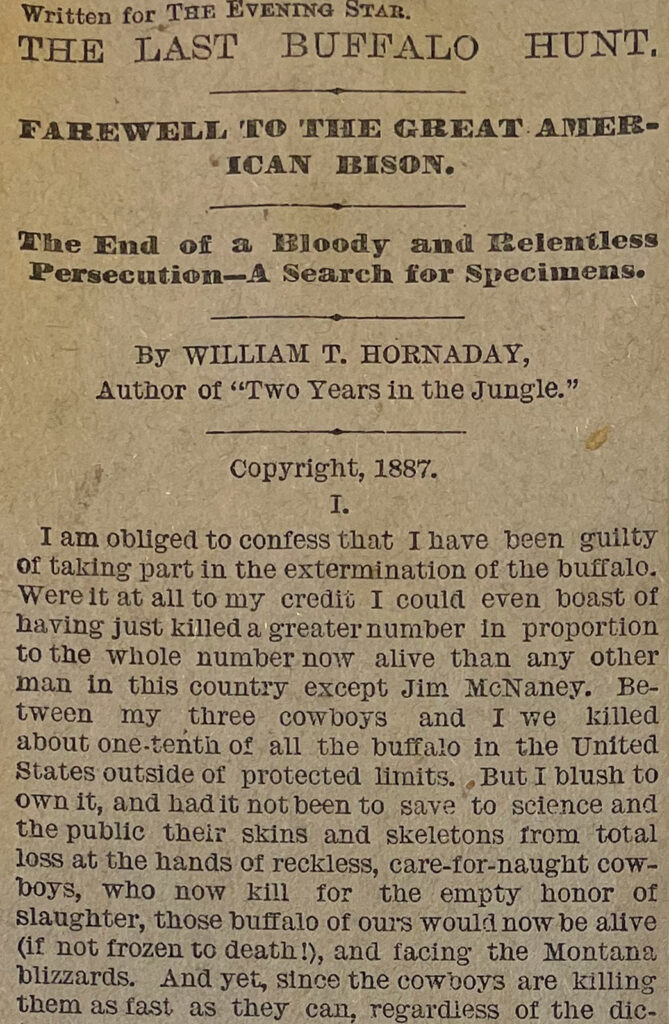
“In view of this alarming state of affairs, it was determined by the Secretary of the Smithsonian Institution to send a party into the field at once to find buffalo, if possible, and collect a large number of specimens in case any were found. Since it was thought highly uncertain whether any other Institution or even private individual would have the forethought to collect a large supply of specimens before it is too late, it was decided by the Secretary that the Smithsonian Institution should undertake the task of providing for the future in a liberal way. For the benefit of the small scientific museums of the country, and for others which will come into existence during the next century, it was resolved to collect at all hazards between eighty and one hundred specimens of Bison Americanus, of which from twenty to thirty should be skins, and an equal number should be skeletons, and of skulls at least fifty.” Hornaday in a “Progress Report of Exploration for Buffalo in Montana,” 1886 (IMG_6633)
Collecting
One of my biggest takeaways from the archive was how it shifted my thinking. I had been viewing Hornaday’s and many of his peers’ work as primarily conservation-driven, when, in fact, it was as much about collecting…possessing. Nowhere is this more evident than in the pursuit of the Bison, not to save them, but to kill and preserve their bodies as a record to show they once existed and as display items in their museums.
Market hunting… Indigenous people… Hornaday and Madison
Context: The Extermination of the Buffalo
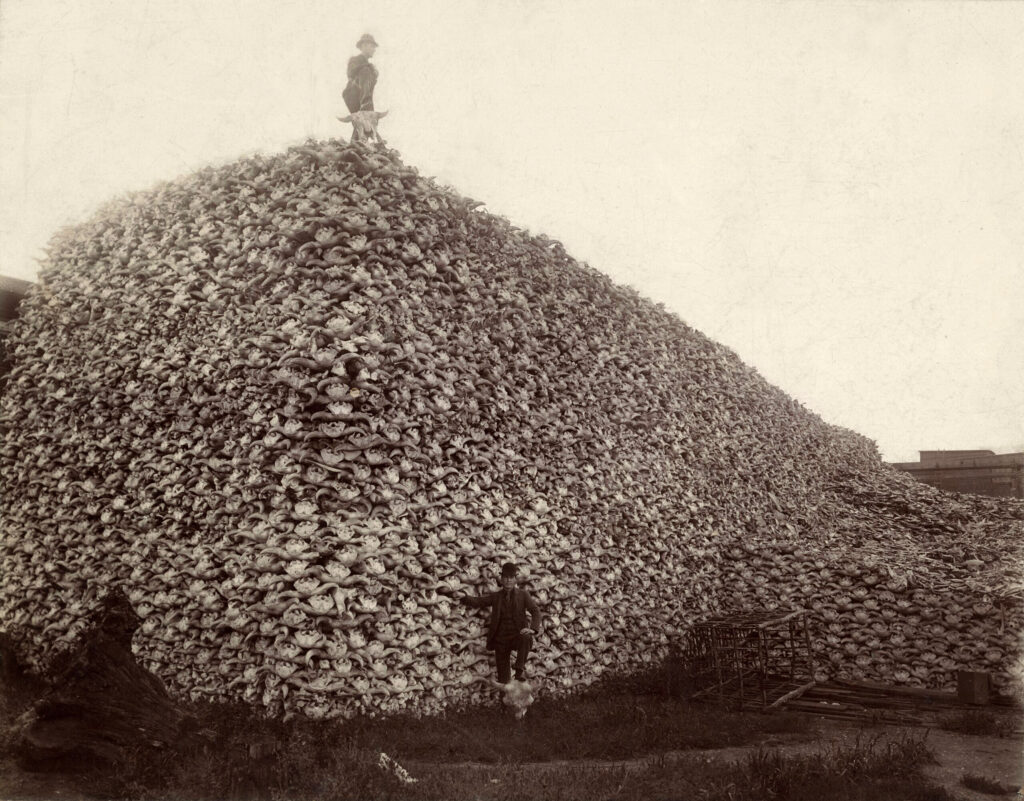
Buffalo (or bison) were hunted for meat, sometimes just hump meat, tongue, or ribs; trophies to adorn the homes of big-game hunters, hides for leather tanneries; or just for the pleasure of the kill and the claim of killing (Jenkinson RB 140). Then there was the United States’ de facto “Indian policy” that called for the destruction of the Native American food supply in order to control them and end tribal sovereignty (Jenkinson RB 140-141). As part of this movement, there was what is known as “market hunting,” which resulted in the famous images of piled bison skulls and bodies you may have seen before.
Roosevelt himself sought to kill a bison in 1883, when he began his four-year stint in the Dakota Badlands, wanting to kill his own before they became extinct (Jenkinson RB 142-143). Later he would meet Hornaday… exhibit.
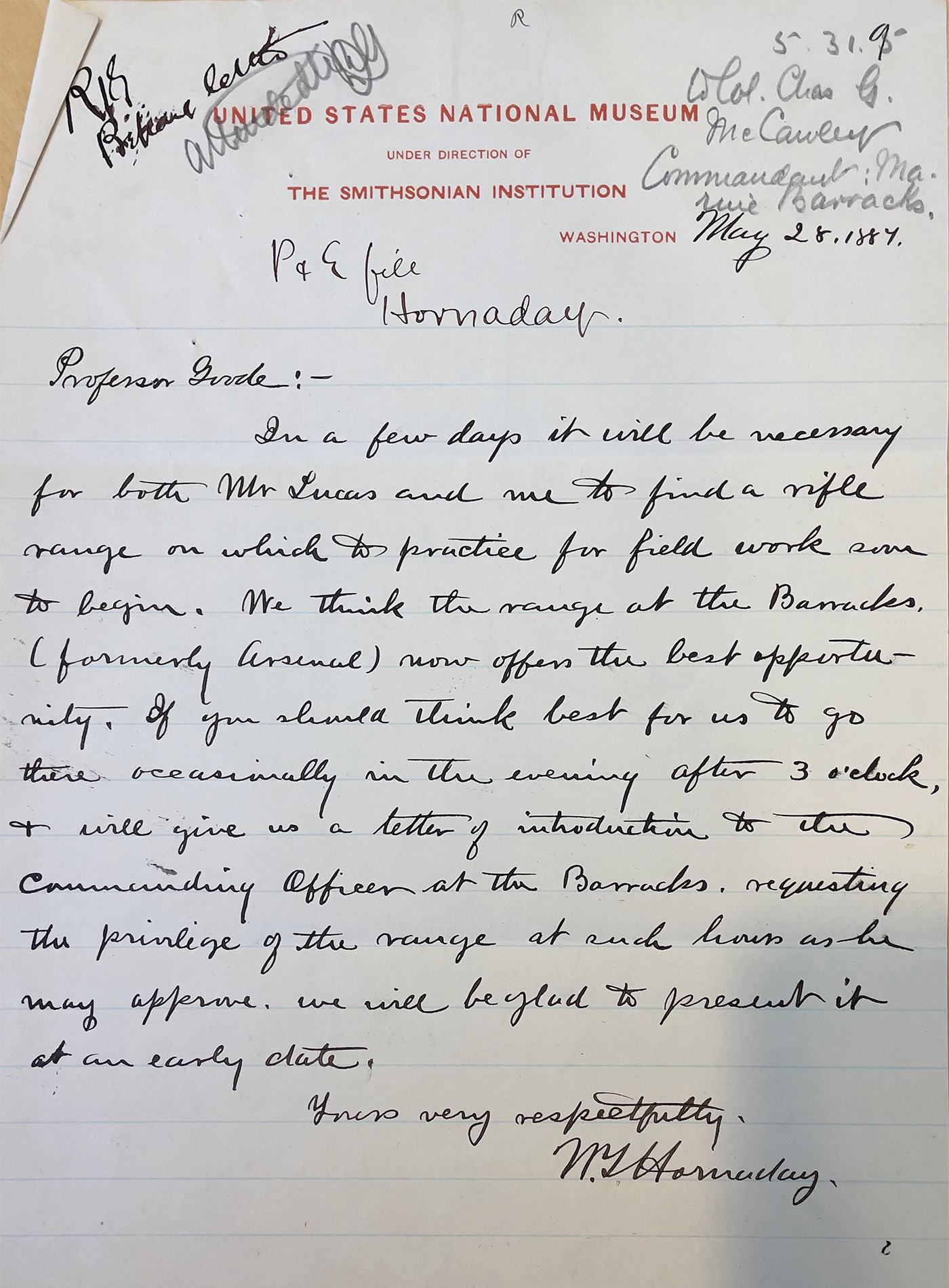
In this letter, Hornaday writes to George Brown Goode (1851–1896) [WHO] asking him to write him an introductory letter to the commanding officer of what is likely the Washington Barracks at Fort Lesley J. McNair in DC. He hopes to use their rifle range to practice shooting buffalo: “In a few days it will be necessary for both Mr. Lucas and me to find a rifle range on which to practice for the field work soon to begin. We think the ranges at the barracks (formerly arsenal) now offer the best opportunity.”
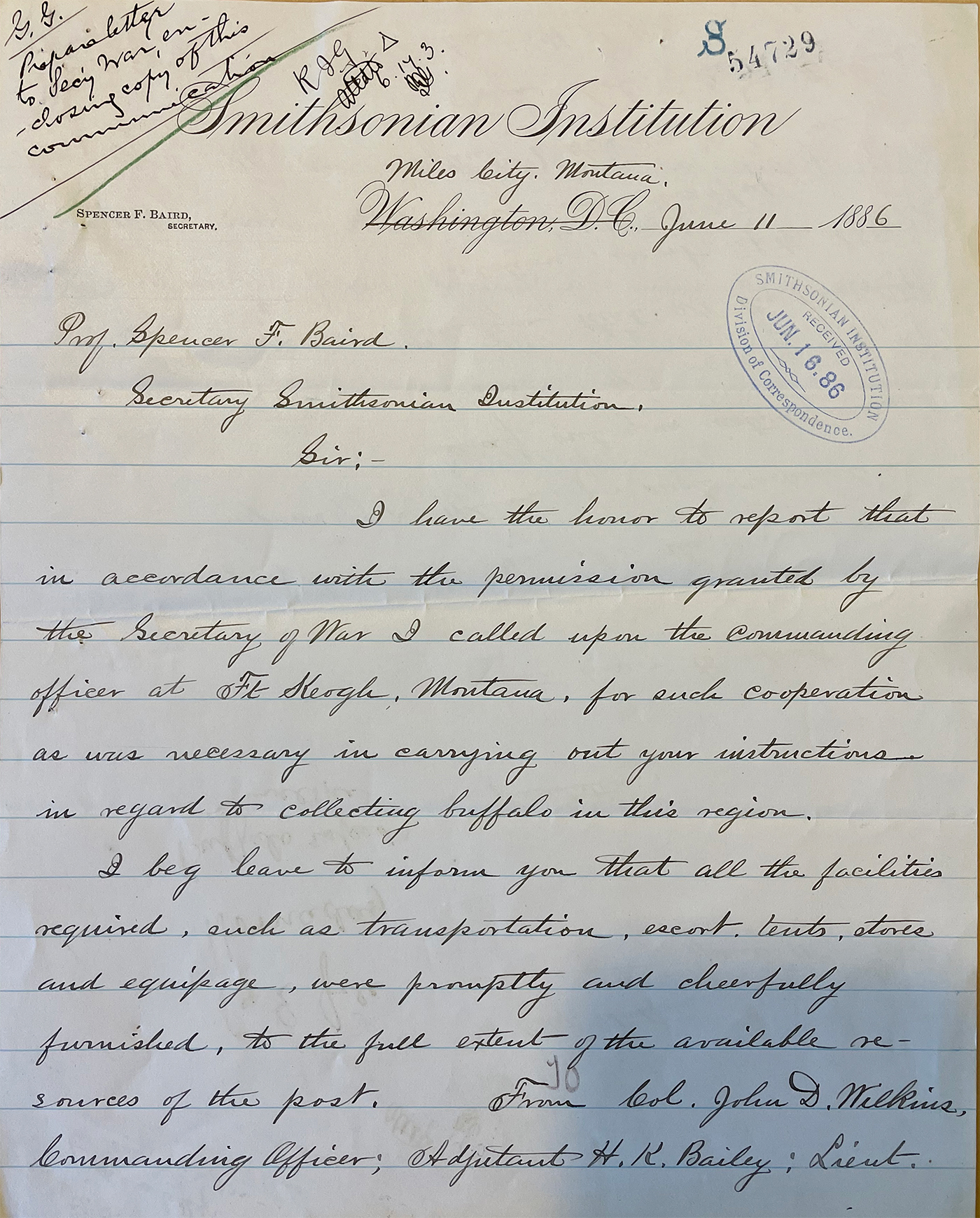
In a letter from Hornaday to Smithsonian Secretary Spencer Fullerton Baird (1823-1887), who drove the institution’s curatorial decisions. In the 1886 letter, Hornaday informs Baird about his success in securing assistance with collecting buffalo: “I have the honor to report that in accordance with the permission granted by the Secretary of War I called upon the commanding officer at Ft. Keogh, Montana, for such cooperation as was necessary in carrying out your instructions in regard to collecting buffalo in the region.” In the rest, Hornaday explains the various resources they were provided and to whom they are indebted.
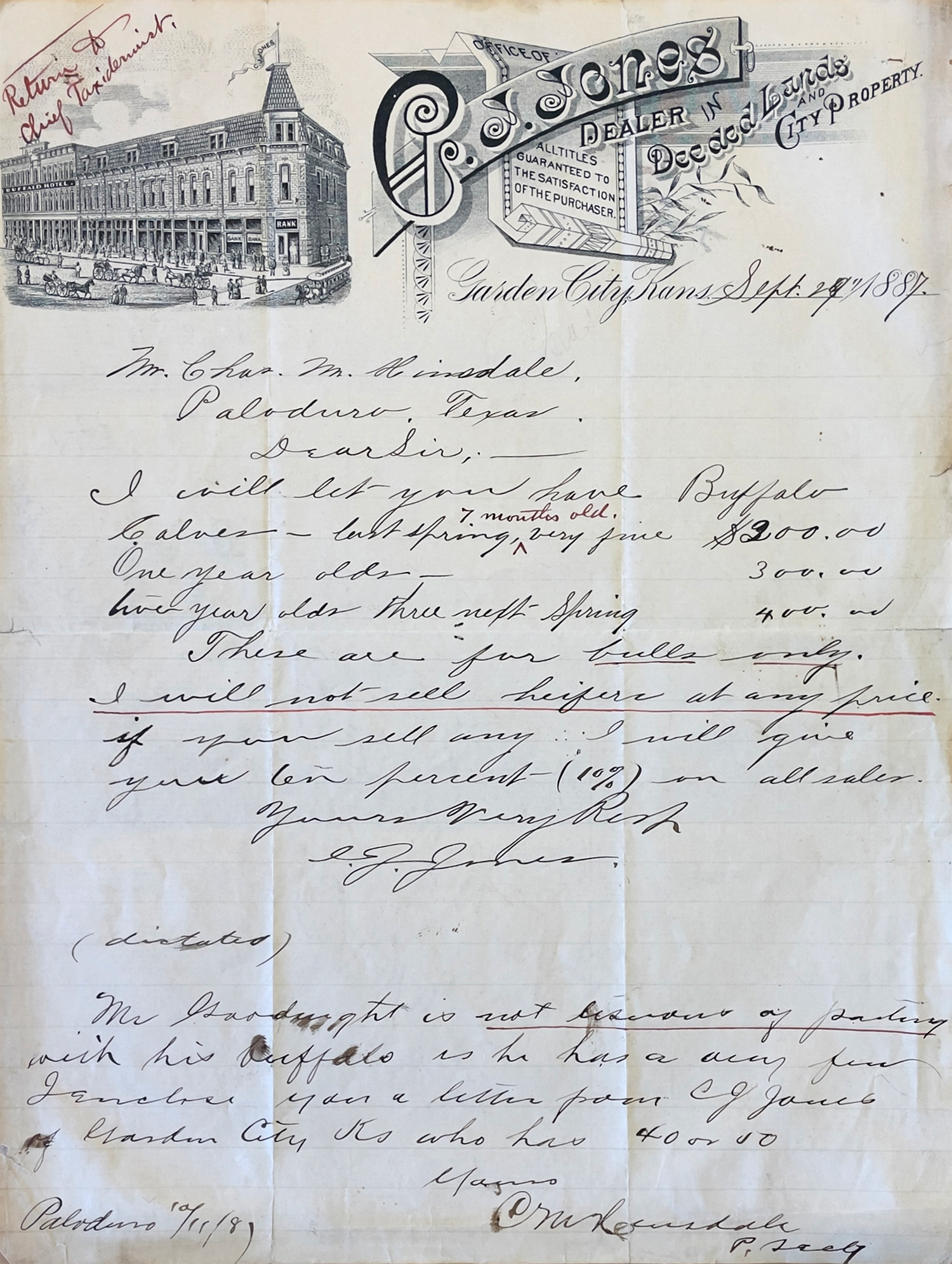
This letter from Charles Jesse Jones, or “Buffalo” Jones (1844 – 1919), seems to have been written to Charles M. Hinsdale and then shared with Hornaday, as indicated by the note, “Return to chief taxidermist” in the upper left corner. The discussion is about the giving and selling of buffalo, including that Jones is willing to only sell young bulls.
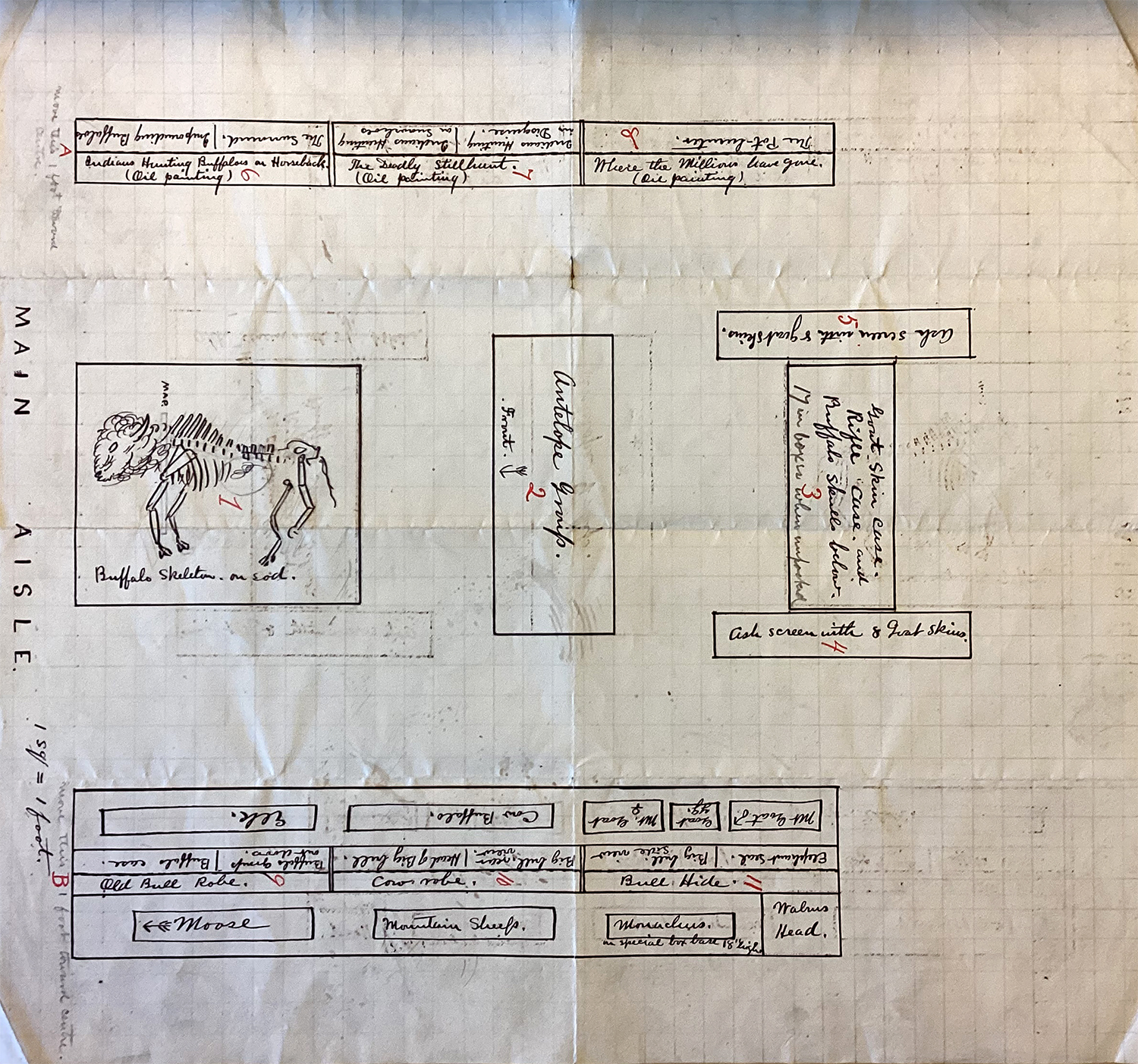
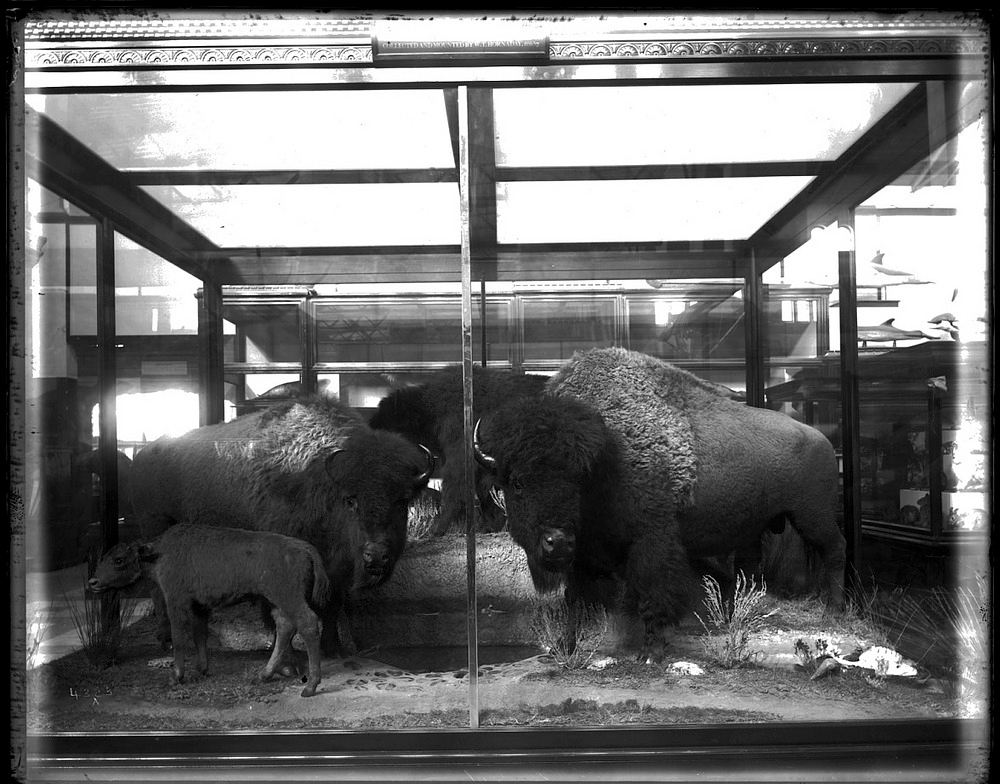
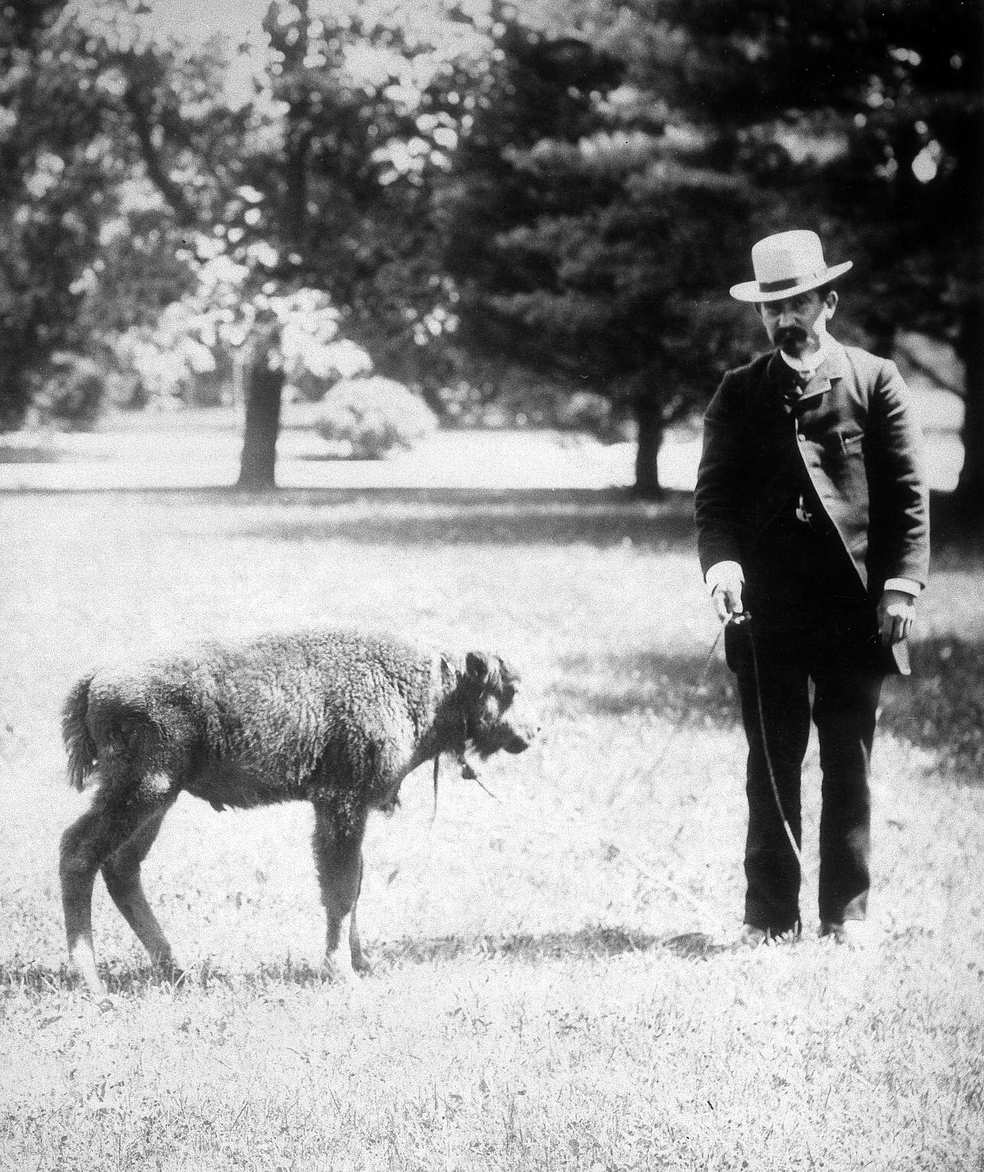
Taxidermy and display
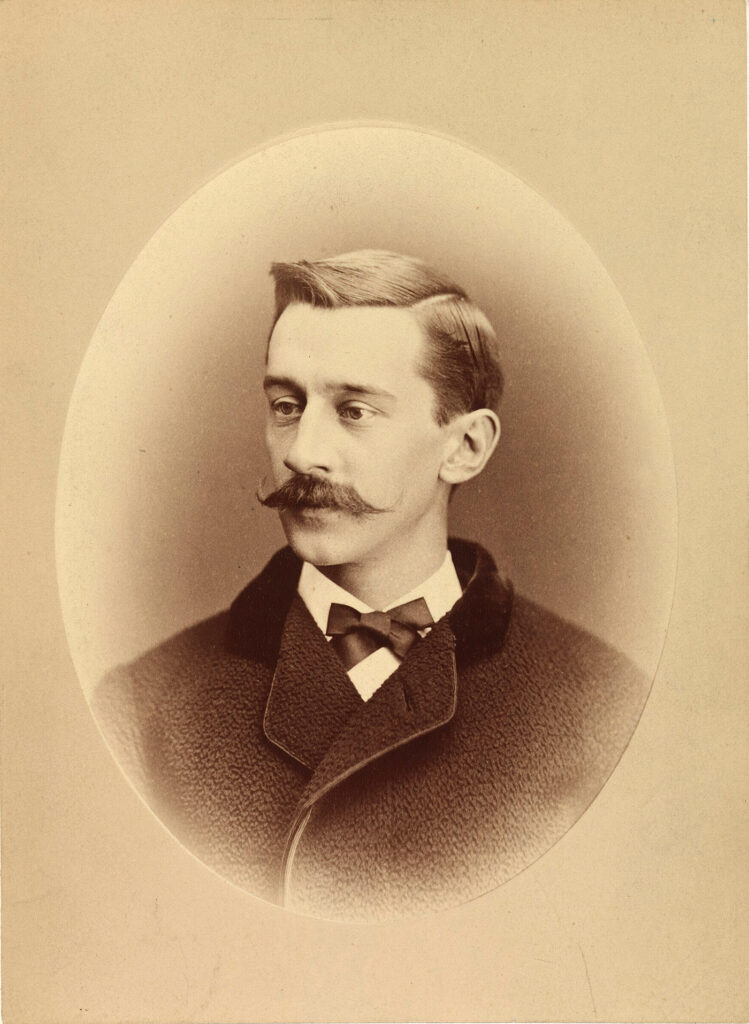
The letters I found from George Bird Grinnell were particularly compelling. Grinnell, a naturalist who played a significant role in the North American conservationist movement, was the editor of Forest and Stream magazine, in which he published…, a member of the Bison Society, and a collaborator with Theodore Roosevelt…Forest and Stream to be a voice for conservation, Boone and Crockett Club,
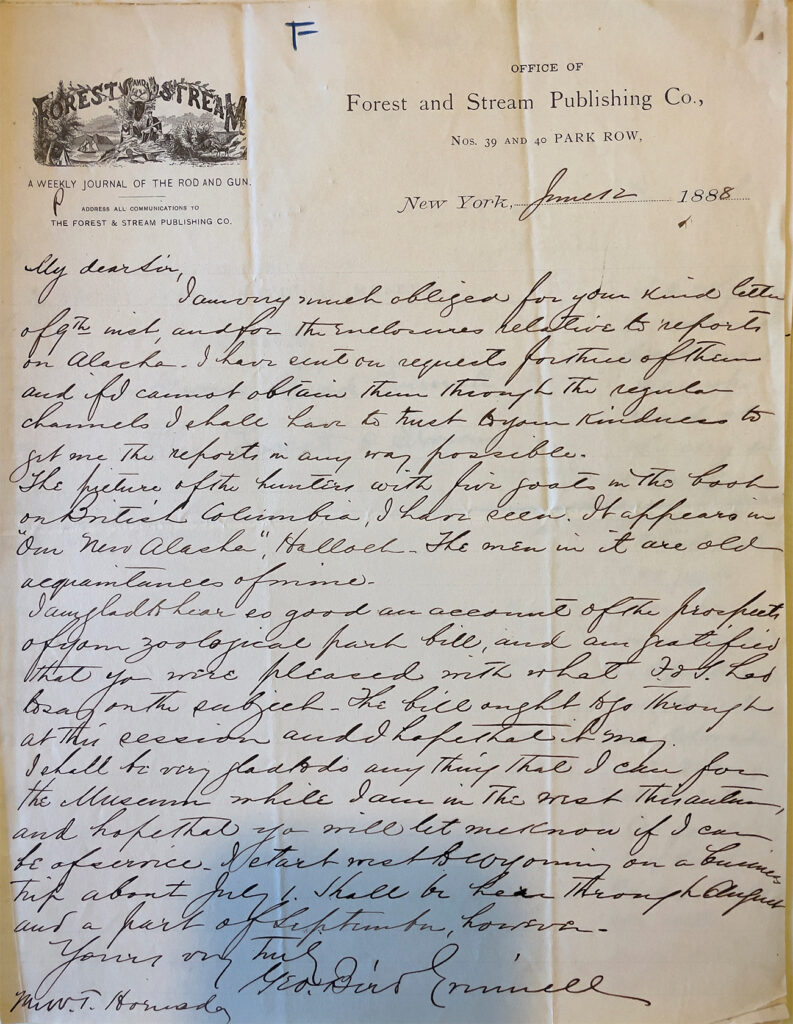
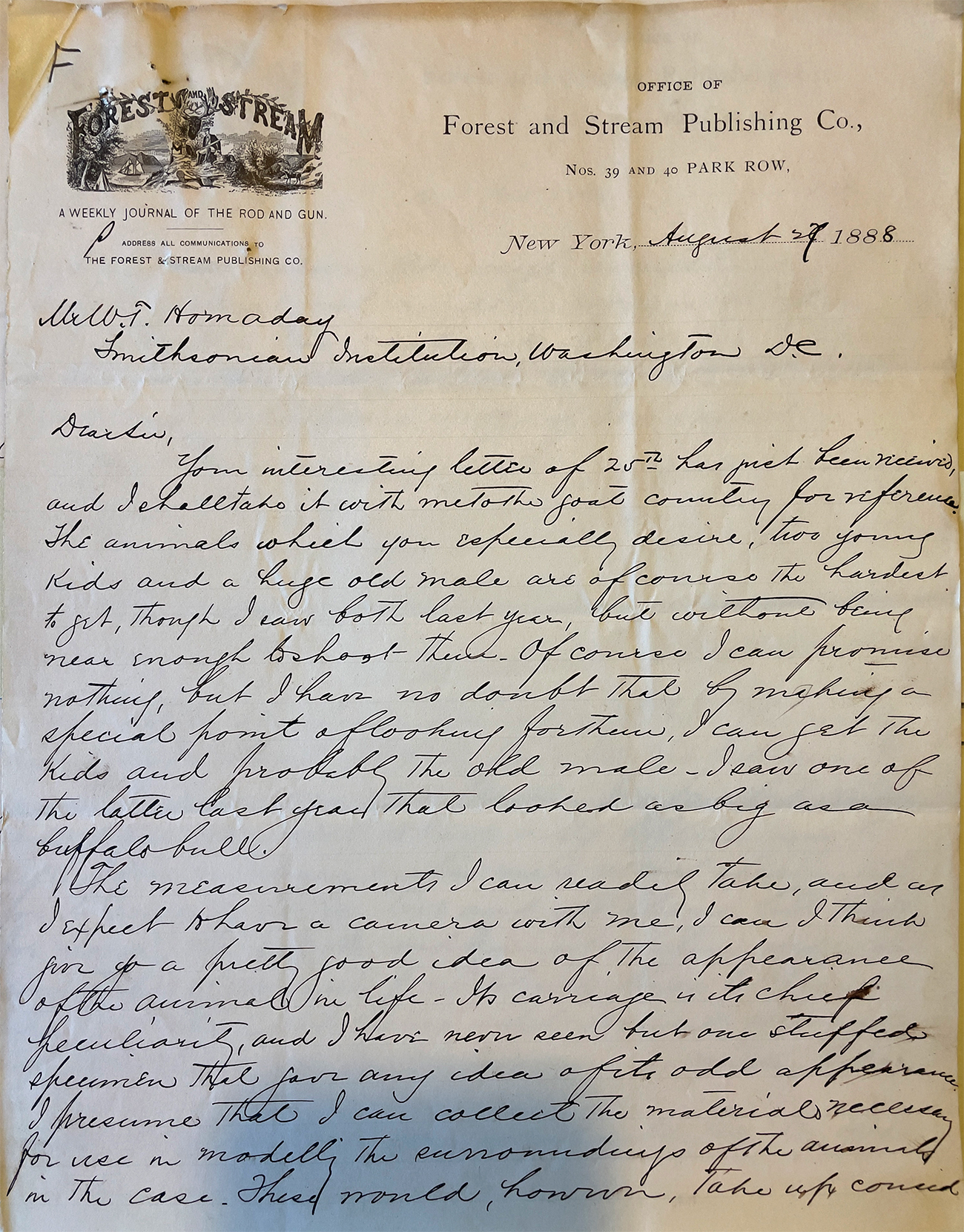
In the June 12, 1888 letter, Grinnell touches on a number of compelling topics…
He requests “reports from Alaska,” presumably wanting to know about conservation or sportsman-related developments that he can publish in Forest and Stream. Expresses excitement about the potential creation of a Zoological Park (what would become the National Zoo in Washington, DC), which was being proposed in a bill in the upcoming congressional session. He was also grateful that Hornaday was pleased with what Forest and Stream had to say on the subject.
See “The Fur Fisheries of the North West Seas,” an example of such a report.
References a letter in which Hornaday requests that Grinnell hunt for him goats: “The animals which you especially desire, two young kids and a huge old male are of course the hardest to get.” He mentions he can take measurements—presumably Hornaday has asked for measurements of certain goats—and Grinnell mentions he will likely have a camera that he can use to capture the animal in its natural state, something much needed in order to accurately taxidermy an animal: “I can I think give you a pretty good idea of what the appearance of the animal in life—its carriage is its chief peculiarity, and I have only seen one stuffed specimine.”
“You will readily understand, I think, that I do not desire to go into the business of collecting for profit, and that I am not likely to have any specimens to sell. If the museum wishes me to collect specimens for it, I will do so for ‘love and affection,’ but not for money.” (page 2)
Mentions Hornaday wanting him to collect information/observations as well, including temperature and humidity, “atmosphere” to help with the creation of the zoo, presumably to create more accurate environments for the animals (page 3). Asked to be telegraphed about the news of the Zoo (page 4)
Conservation Movement
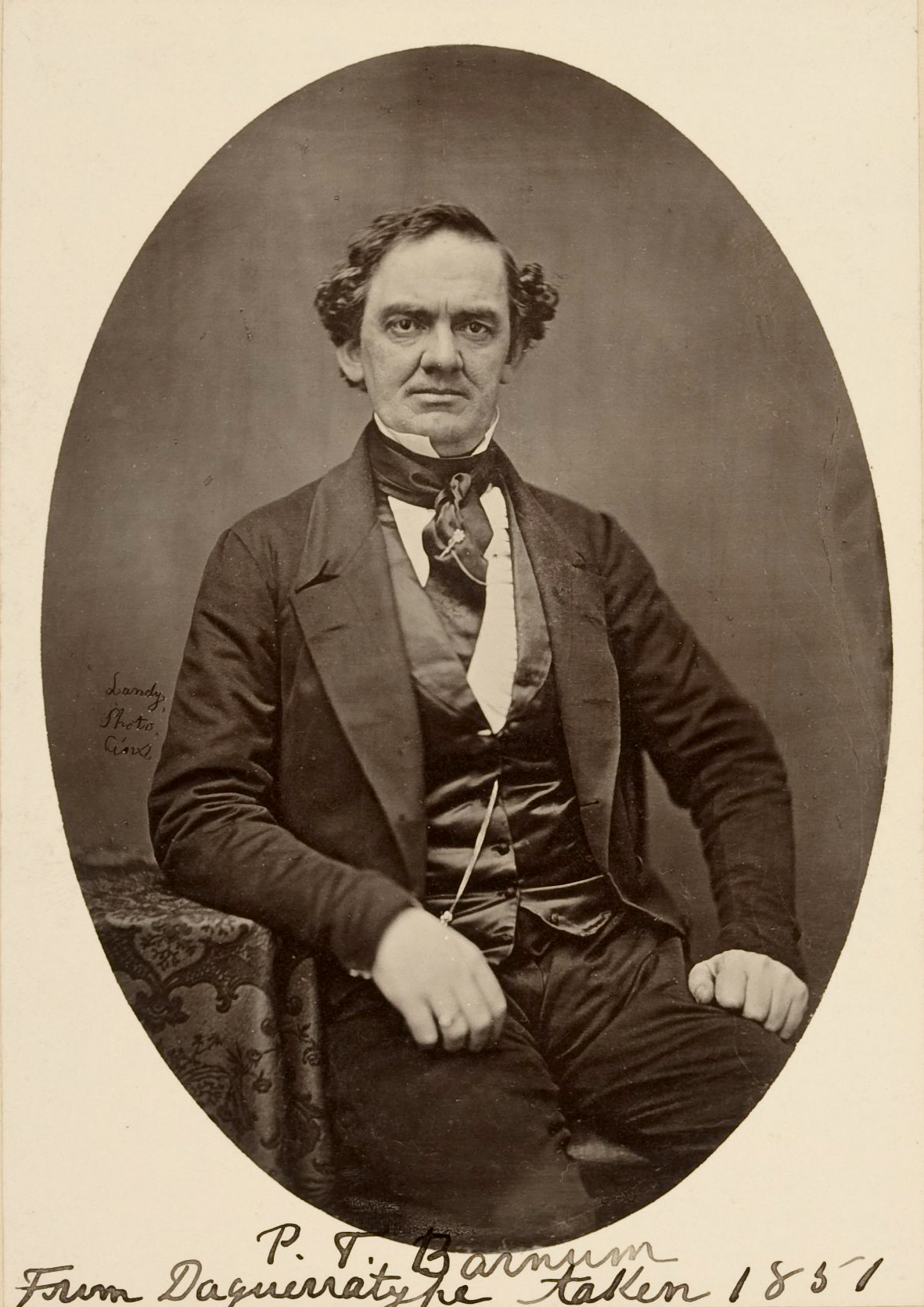
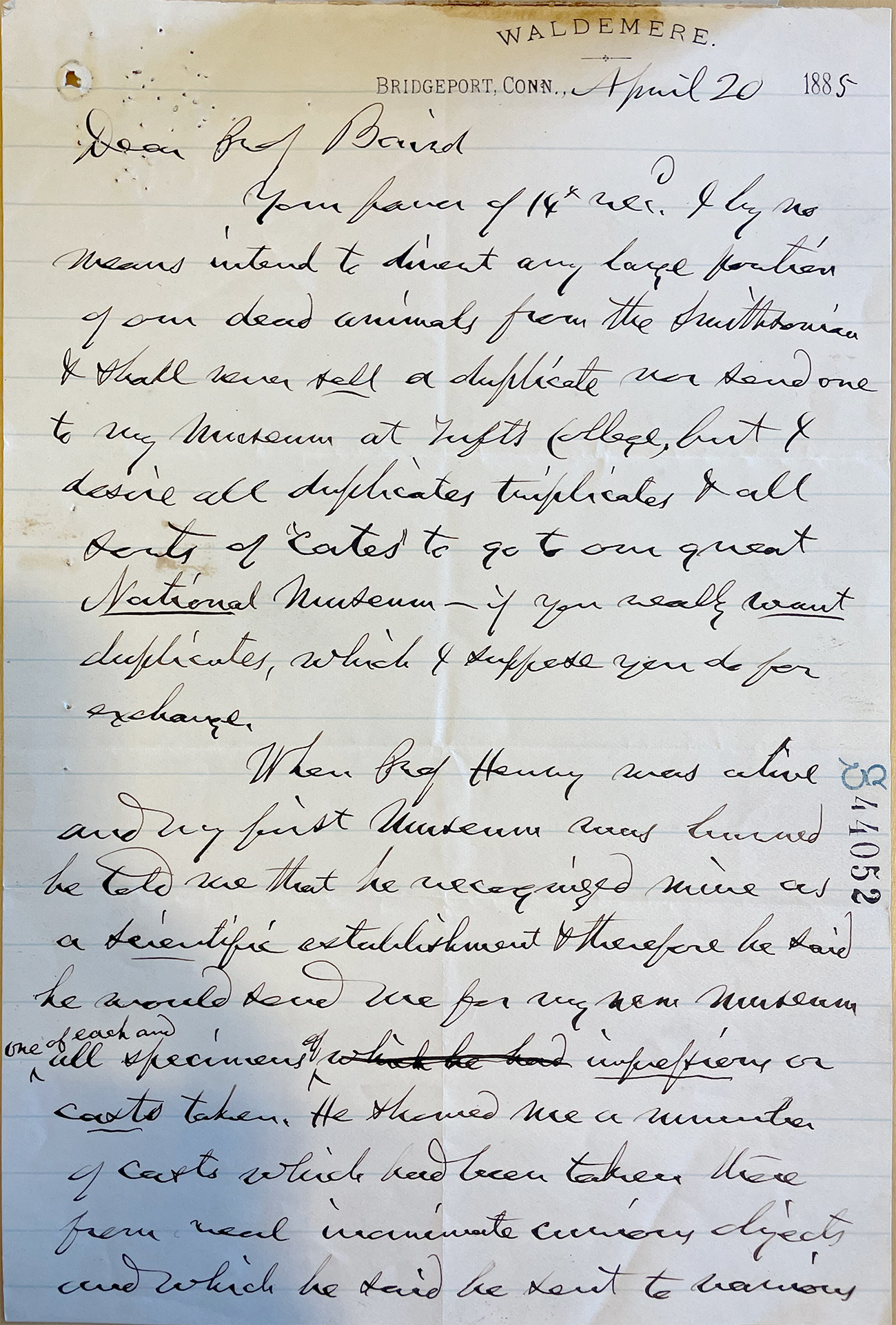
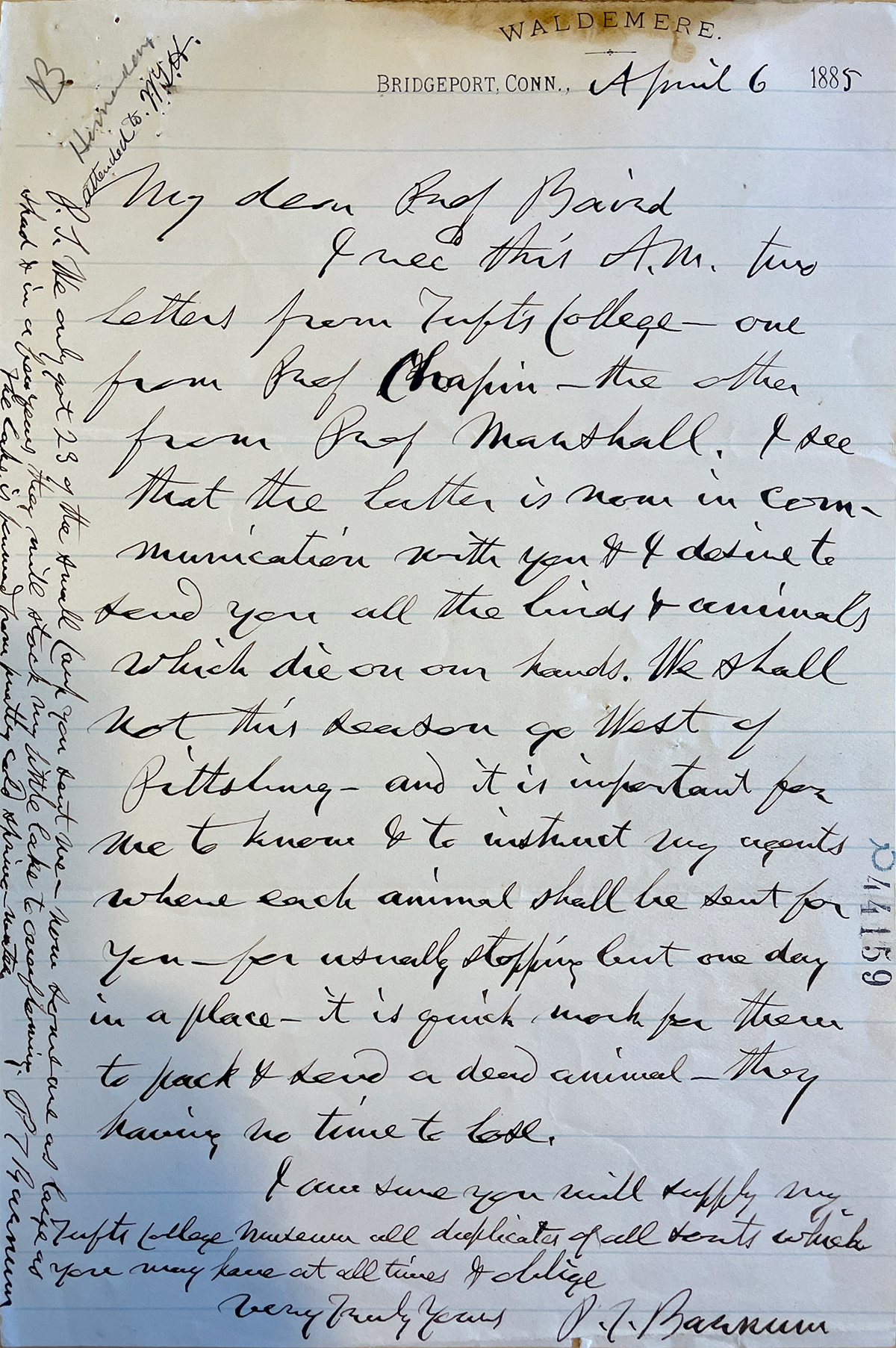
A letter dated October 31, 1883, written by Barnum to Professor Spencer Fullerton Baird, sought to know whether a vicious elephant can be castrated (IMG_6362). Baird consulted Hornaday, who said, “No,” and that he believed it would result in death, and said a change of keeper and treatment, as, according to him, “Under proper treatment, elephants are not vicious except when actually insane.” Nov 6th 1883 (IMG_6364)
Collecting and exploiting
https://dl.tufts.edu/pdfviewer/5t34sw43t/cc08hs43c