
As a pioneer in wild-life photography, I regard with intense satisfaction the place the camera now occupies in the equipment of the sportsman as well as in that of the field naturalist. The latter recognised its value almost as soon as dry plates were available. But the former was not convinced of its superority to the rifle until improved apparatus enabled him to obtain photographs of big game which were not only more beautiful than mounted heads or rugs, but where far more impressive evidences of his prowess as a hunter. (xix)
When discussing hunting with cameras, it is important to give at least a brief mention of George Shiras, III, a key figure in the development of the wildlife photography movement. Shiras was a lawyer, a Pennsylvania state legislator, and a Pennsylvania Representative in the US Congress, whose love of hunting with a rifle evolved into a love of hunting with a camera, an interest rooted in his turn toward naturalism and conservationism. With this in mind, it is not surprising that when he served as a Representative, he pushed for major conservation legislation, including the Migratory Bird Treaty (271).
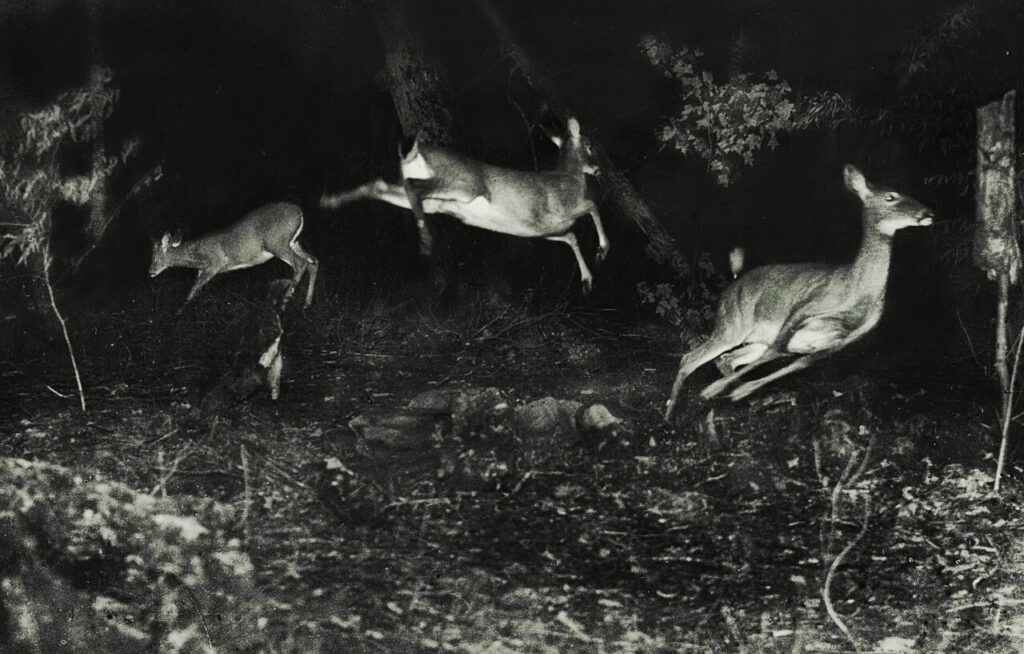
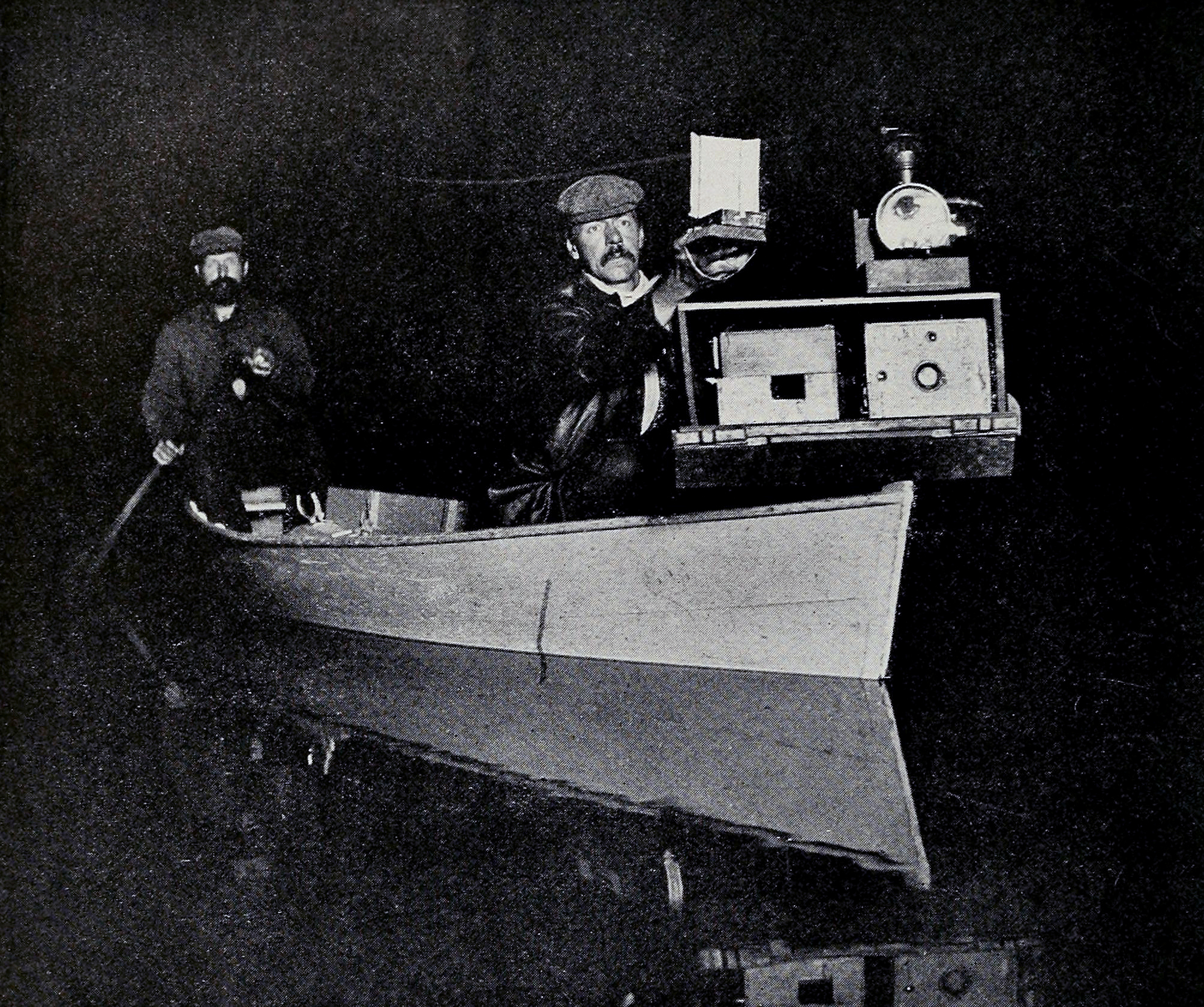
What made Shiras’ photographs so unique and striking was their recording of live animals in the wild, often at night, a feat that had never been accomplished before. He was able to capture animals through hunting-like means, using camera traps, spring-loaded devices with trip cords, and the like, which allowed him to trigger the camera remotely and photograph from a canoe using a system that synchronized a jacklight, flash, and camera shutter to photograph (47). His collaborator, John Hammer, assisted him on shoots and, as a former optical machinist, had the skills to build the mechanisms they designed (54?). Shiras’ works were so attention grabbing that when the US government was curating its materials for the 1900 World Exposition (World’s Fair), it requested a set of enlarged prints that were so well-received that they were given the highest photography award (viii).
Shiras crossed paths with the likes of Theodore Roosevelt, who was a judge of a Forest and Stream photo contest Shiras had entered (CITE). The two became friends, and several years later it would be Roosevelt who, after trying many times, convinced Shiras to write his book Hunting Wild Life with Camera and Flashlight: A Record of Sixty-Five Years, a two-volume (volume 1, volume 2) culmination of his life’s work (99 and 260).
When giving a lantern slide lecture at the Boone and Crocket Club, Shiras got the attention of Gilbert Grosvenor, National Geographic Magazine‘s first editor, who was in attendance. So impressed was he that he asked Shiras if he could publish his photographs in his magazine. The result was the July 1906 edition, featuring the headline “Photographing Wild Game with Flashlight and Camera,” which included seventy of Shiras’ photographs. National Geographic Magazines would continue to publish his work, and in 1935, published Shiras’ book.
Though his work ignited the wildlife photography movement, Shiras never described himself as a wildlife photographer. Instead, he always called himself a “camera hunter” (CITE)….
McAleenan Hunting Party and Photography
Sources
Developing Animals
Hunting with Rifle and Camera
Book on Shiras